From Preaching to Leading
We’re going to talk today about education systems and a few of the problems we are facing right now. If we examine how we teach closely, we see it is still a "one-to-many" approach. We live in a world where knowledge is in everyone's pocket—it has been that way for a while, but in the last couple of years, that abundance of knowledge has become almost ridiculous.

The Traditional Model
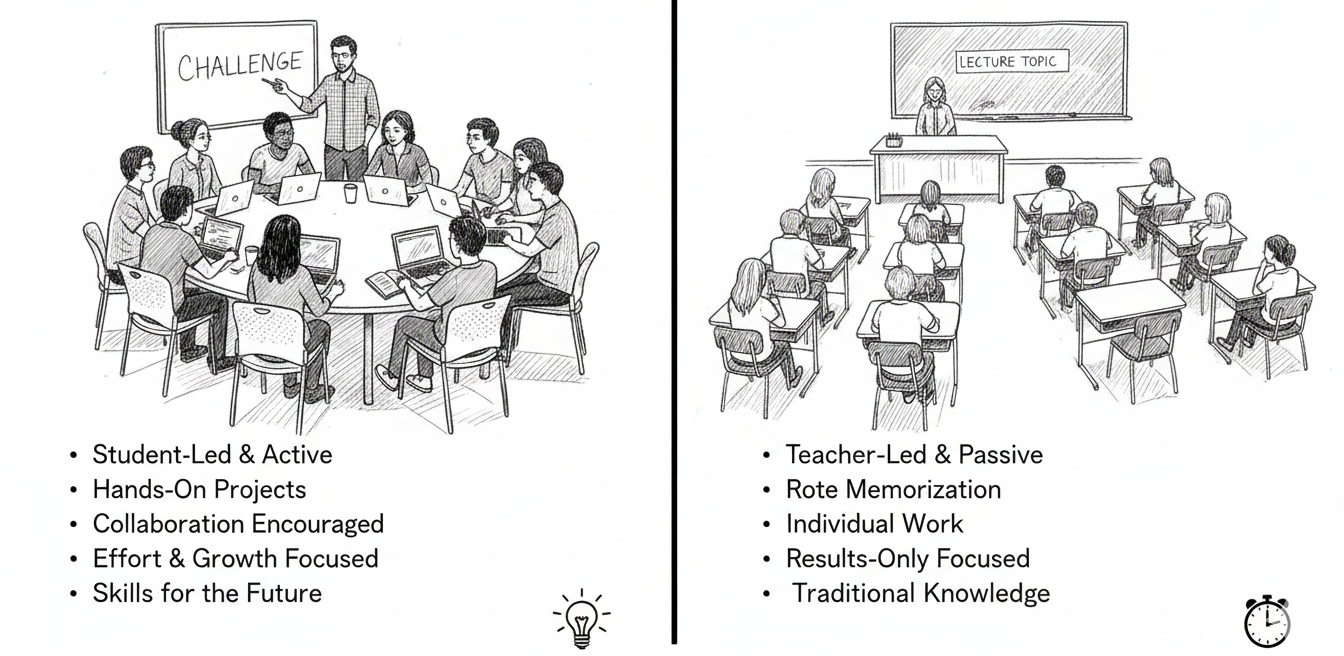
Despite this abundance, we still use the same form of grading based on exam results. We have the same style of teaching; we could even call it "preaching". One teacher talks to 20 students, and as they grow older, it scales to 30, then to 60 or 120 in higher education. We teach them something and then grade them based on their results on a single exam.
To be fair, this system has proven itself because we got to where we are. I'm not saying the system is "bad," because if you look around, we live extraordinary, incredible lives. We have hot and cold water, microwaves, and fridges. We have communication systems that allow us to talk to loved ones all over the world. We share information with incredible speed and abundance, largely free of charge. We have turned humanity into something united—it’s amazing.
New Challenges at the Top of the Pyramid
However, we still have ways to improve. Kids spend 18 to 21 years in the education system. The first seven years are incredible—they are at home, and then they go to kindergarten, which is playful and amazing. But then, they are introduced to "the class". While everything else in the world has changed, the education system has stayed the same.
We need to ask: how can we improve the way our kids feel and behave? The role of the education system is to develop young people into adulthood so they enter society in a beneficial way. We’ve already built the foundation of the Maslow pyramid—we’ve largely taken care of shelter, food, and safety. Now, we are reaching the higher end of the pyramid: emotional safety, equality, and fulfillment.
This is where the current system struggles. Grading based on results doesn't always have a positive effect on the individual. For example:
- One student might do exceptionally well on a test with very low effort and still get a high grade.
- Another student might put in massive effort but receive a lower grade because their results weren't as accurate.
By focusing only on results, we miss the opportunity to tell our people: "As long as you make an effort and keep showing up, you will make it". We want them to know the most important thing is to show up, do the work, and improve.
A Different Approach: The Workbook Method
I don't think we need to change the entire system at once. As individuals, we have a responsibility to our own circles of students to incorporate better ideas.
Take software engineering as an example. The "old way" is a one-to-many lecture where a professor teaches Python. Lectures have their place—I’m a professional speaker myself, so I think they are important—but they shouldn't be the only way.
Instead, we can build a workbook of challenges. Imagine a big circle table with laptops and no lectures at all. The students just need to complete the workbook. We don't care how they do it; they can use the internet or any other resource, but they must finish the work.
Small Steps Forward
This is a completely different approach, and I believe it is a better, more helpful one. If we can do this with software engineering, we can do it with:
- Graphic design
- Bookkeeping and accounting
- Entrepreneurship and business management
- Even health
We don’t need to change everything overnight to fit this model. But we can incorporate more of it into our student circles right now. We don’t need anyone’s approval or permission. We can decide this with our students today. These are the small steps we can take toward a better system overall.